



The Architecture Behind AI Agents That Remember

Agent memory is an architecture decision. Learn to design it across seven stores and defend it in design review, with Oracle’s Nacho Martínez Rincón.
🗓️ Sat 21 Nov, 11 AM ET · Live 4-hour workshop
✍️ From the editor’s desk
Welcome to the 69th issue of Deep Engineering!
This week, thousands of CIOs and IT leaders gathered in Orlando for Gartner IT Symposium/Xpo, and one of the first findings Gartner shared set the tone for the rest of the conference. In a survey released on 19 October, only 13% of CIOs said their enterprise had realized significant or transformational value from AI so far. “Volume is not value,” Gartner VP Analyst Alicia Mullery told attendees, pointing to organizations that never defined what a use case should deliver before they started building.
Engineers are working through the same lesson at a personal level. As AI writes more of their code, many experienced developers and architects are asking what their years of expertise are still worth. Some describe the most enjoyable stretch of their careers, while others say AI beats a decade of their experience in an hour.
Bruno Souza has been helping developers grow their careers since 1995, as founder of SouJava and co-author of Developer Career Masterplan. In today’s feature, he explains why your value was never the number of lines of code you write, and why the bigger risk is handing your thinking to AI instead of using it for the work you never wanted to do.
Let’s get started.
Explore 👉 Agentic Engineering Platform
Agentic Engineering platform pairs practitioner-led workshops with the Guild, a live community where the conversation keeps going after the session ends.
🎟️ Extra 20% off on any workshop with code AGENTIC20
🧠 Expert Insight
Navigating Your Career as a Software Architect
by Bruno Souza, Java Champion and co-author of Developer Career Masterplan. This piece is adapted from his talk at ARC 2026, Packt’s virtual conference, and was written up by the Deep Engineering editors in his own words.
Everywhere I go, I meet people who are very happy with AI and people who are very worried about it. An open source developer with more than twenty years of career told me it frees him from the stuff he doesn’t want to do. A developer with twelve years of career told me it beats his decade of experience in one hour, and he wanted to know how he could compete with that. If you’re worried about your future, it’s not craziness on your part, and I’m not going to tell you everything will be amazing. But you’re going to have to think differently, for sure.
You will be fine
I think there’s a delusion in the market right now. Managers, directors and even CEOs are prompting AI to write code for them, and some of them conclude they don’t need developers anymore. I can’t believe that with more code being generated and more software being created, anyone thinks we need fewer developers. It’s like saying we have more food now, so we need fewer cooks, or more books, so we need fewer writers.
People who love to write code will keep writing it, the same way people who love to write books will keep writing them. And something much better than AI code already exists. It’s the open source software that already does most of what you need, which a lot of teams still ignore while they build their own frameworks.
Your company might be one of those crazy companies, and you might even lose your job. But developers, architects and technical people will be fine. I’m not worried about developers, and I’m even more confident about architects, because a lot of people are looking for architects.
Use AI for you, never as you
A while ago, I saw a presentation by an anthropologist here in Brazil about an old experiment. In 1931, two psychologists raised a baby chimpanzee alongside their own baby son. The chimpanzee was better at almost everything at first, because chimpanzees develop faster. Then it came time to speak, and the chimpanzee couldn’t follow. It never learned to talk, and the baby started making the chimpanzee’s noises instead.
That’s a really interesting analogy for AI, because AI does not learn with you. It does not improve, and if you need a better AI, you train a new model. But you get better, and your brain has a capacity that goes far beyond what AI can do. AI gets you from zero to average immediately, but it’s not going to take you somewhere amazing.
AI is a great tool. The problem starts when we stop seeing AI as a tool and start seeing AI as us. That’s what we call cognitive surrender, when instead of using your intellect and your imagination, instead of being you, you let AI be you. My wife ran into this a few weeks ago with a support agent that kept promising to fix her problem without ever saying it was an AI. When she finally reached a person, the company had never received her request, and of course they lost the customer.
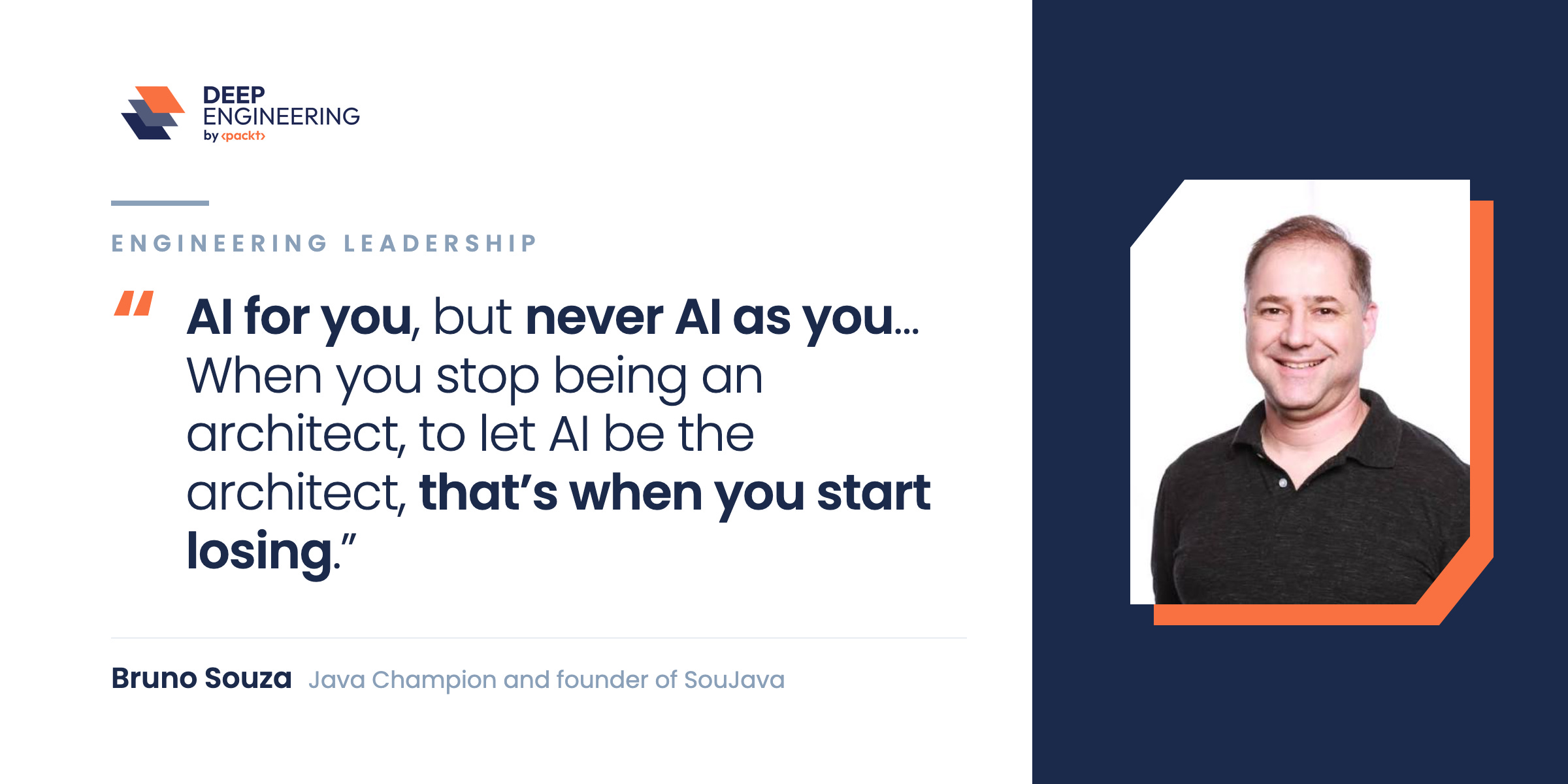
So use AI for you. The best use case I’ve found is the things I don’t want to do, and skipping work you don’t want to do isn’t laziness. Buying an electric hammer that hits nails faster doesn’t make you lazier either. As an architect, using AI to help you define things, understand things and plan what needs to be done is a good thing. When you stop being an architect and let AI be the architect, that’s when you start losing.
And remember that there is no intelligence in artificial intelligence. It’s a mathematical calculation, and the intelligence is in the people who built the formula. An LLM will tell you with total certainty that it wrote the code and checked the security, and the moment you point out that anyone can access the application without logging in, it tells you you’re right.
Your value was never lines of code
For many years, we asked our customers and our bosses to tell us exactly what they wanted, and we rarely got a clear answer. Now everyone says AI needs all the context and all the clarity about the problem. I think our job as architects gets better, because we’ll finally get the information we always asked for.
But even that isn’t enough. I tried specifying a tiny application as completely as I could so the AI would build exactly what I wanted, and it still built something different, because some things weren’t clear enough. If you just leave it to the AI to talk to people and build the specification, it’s not going to ask the right questions. That’s why communication is one of the most important skills an architect needs, with AI and with the people around you.
If I had told you a few years ago that your value as a developer was the number of lines of code you write, you’d have been offended. You’d have said you’re the one thinking about the problem and asking the right questions. That’s still true today.
Go after the big problems
The best career you can build starts with the biggest problems you can see coming. The larger the problem, the more responsibility and autonomy you get, and the more valuable you become in the market. Think about the year 2000 bug, where a lot of people built careers making sure companies didn’t crash. The 2038 time rollover could become that kind of niche.
Just don’t use AI to imagine that future for you, because AI has no notion of the future. Think about 2038 yourself, and use AI to see the data and the trends that lead there.
There are big problems inside AI itself, too. Right now we’re surfing a wave that investors are paying for, and nobody has solved how to make AI cost effective yet. That could be a great problem to solve. For students and juniors, the most important thing we can do is help them want to build things and fix the world, because the more they want to do, the more they’ll learn, and they’ll use AI as a tool to get there.
Reputation takes you further
Ask yourself what has to happen by the end of next year for you to have an amazing career, and then ask why you can’t have that right now. The answer to the second question is your biggest challenge, and that’s where to start working.
I always use AI for me, and I never use AI as me. My book and the content I create aren’t AI generated, and when I share my email with people, it’s because I want to build a real relationship with them. AI gets you in the game, but reputation is going to get you as far as you want.
Continue reading → how Bruno Souza thinks about architects’ careers, read our Engineering Leadership feature, Cognitive Surrender Is the Big Career Risk for Software Architects.

🛠️ Tool of the Week
Structurizr - turns software architecture into code, generating every C4 model diagram from a single model written in the Structurizr DSL.
One model drives every diagram, so the views never drift apart
The reference implementation of the C4 model, built by its creator
Works in a browser playground or locally through Docker
Apache 2.0, with the latest release on 19 September
📎 Tech Briefs
Gartner’s top strategic technology trends for 2027 - Includes agent coding harnesses among its 2027 trends, addressing governance risks as software generation outpaces human review.
Gartner’s 2027 IT spending forecast - Forecasts worldwide IT spending of $7.35 trillion in 2027, up 15% as AI infrastructure investment accelerates.
Node.js security releases - Updates for Node.js 26, 24 and 22 fix vulnerabilities affecting HTTP, DNS, TLS and cryptography.
TypeScript 7.1 Beta - Introduces a new programmatic API, allowing tools to access the native compiler’s syntax and type analyses.
Rust 1.99.1 - Fixes incorrect boolean returns from Rust FFI functions on x86_64, preventing invalid values reaching foreign callers.
That’s all for this week. If you take one thing from Bruno, answer his two questions in writing before the week is out.
Keep building,
Saqib Jan, Editor-in-Chief, Deep Engineering
Partner with Deep Engineering
If your company wants to reach senior developers, software engineers, and technical decision-makers, speak to us about partnering with Deep Engineering