



Explore Agentic Engineering Platform

Agentic Engineering’s platform pairs practitioner-led workshops with the Guild, a live community where the conversation keeps going after the session ends.
🎟️ Extra 20% off any workshop with code AGENTIC20
✍️ From the editor’s desk
Welcome to the 68th issue of Deep Engineering!
On 13 October, Wharton Human-AI Research and GBK Collective published The Adaptive Advantage, their fourth annual study of enterprise AI, based on a survey of 1,416 US leaders and employees. Eighty percent of leaders report positive returns from AI, but only 28% call those returns strongly positive. Departments that measure AI against growth outcomes are nearly three times as likely to report strong ROI as those measuring efficiency alone, yet hours saved is still the most common yardstick. The companies reporting strong returns were also no more likely than others to have cut staff.
The study found a second gap. Leaders and employees are describing two different transformations, with 73% of leaders saying AI has significantly changed how their departments work against 58% of entry- and mid-level employees.
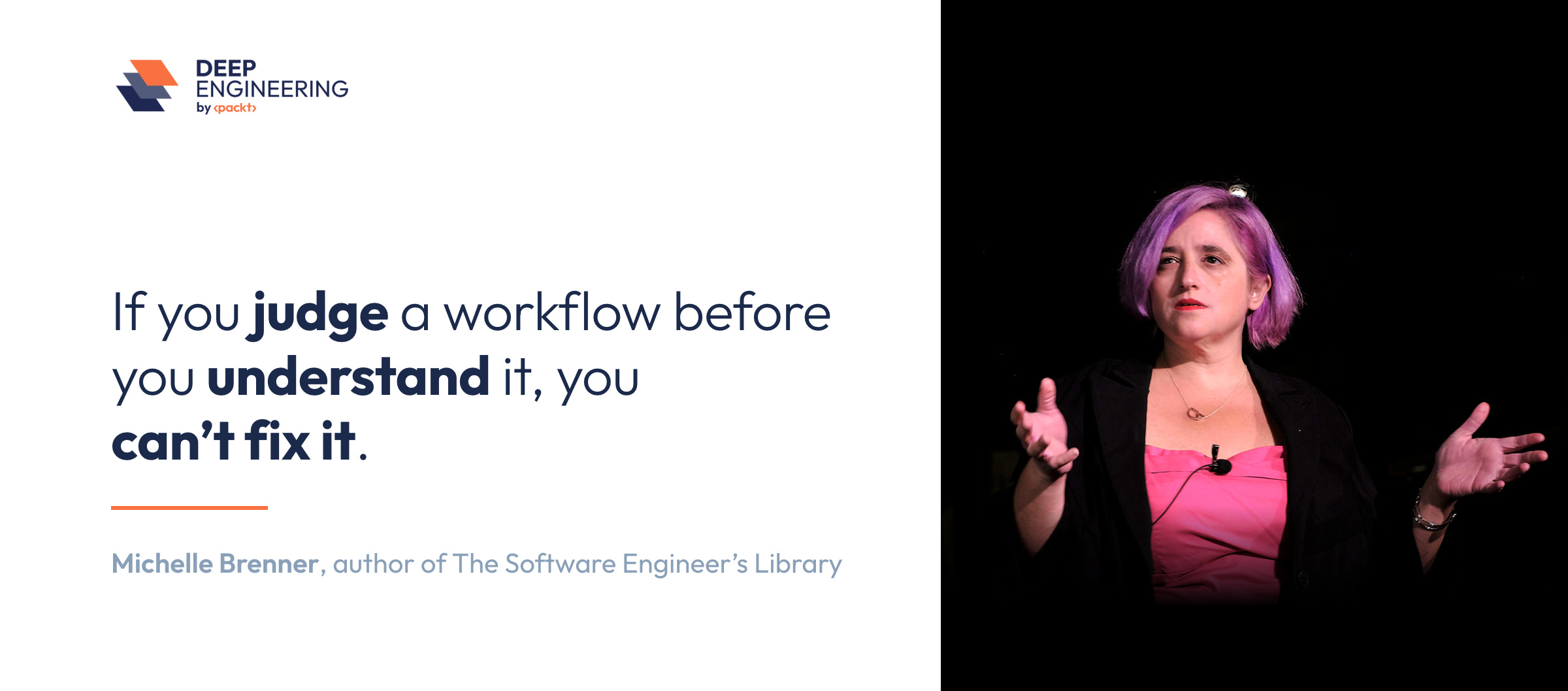
That gap is exactly where engineering leader Michelle Brenner starts. At ARC 2026, she mapped four leadership personas whose AI goals pull against each other, with executives chasing lower headcount while engineers try to keep their jobs and learn new tools at the same time.
In today’s deep dive, she lays out how to redesign the work itself, starting with her own workday.
Let’s get started.
⚡ Graph Engineering for AI Agents
Join Denis Rothman to turn agent workflows into measurable graphs, so you can calculate reliability and catch broken dependencies before the workflow goes live.
🗓️ Sun 25 Oct, 10:30 AM ET · Recording & Recourses included
🧠 Practical Deep Dive
AI Adoption Pays Off Only When You Redesign the Workflow
by Michelle Brenner, author of The Software Engineer’s Library
When Packt reached out to me to give a talk on engineering leadership and AI, I was excited, because this is the giant elephant squeezing every other thought out of the room. I was also concerned. There is so much information out there that I wasn’t sure I had anything new to say.
After pondering some more, I realized the problem isn’t the data. It’s the analysis. Like DNS and time zones, it’s one of the bigger problems in modern software that we just haven’t truly solved. Your phone tracks everywhere you go and everything you search, and you still mostly get ads built for a generalized version of you. AI is going through the same thing, with so many headlines pulling in so much data that they create confusion and chaos instead of comprehension.
So I set two goals. The first is to align AI goals between engineers and leadership. When peers are in conflict, it’s usually because their goals are in conflict, not because they’re terrible people, and it’s the job of leaders to spot those systemic problems and get everyone into alignment. The second is to decrease fear to make space for innovation. People don’t do their best work when they’re scared. It’s like that common advice about gambling, that you can’t win if you’re afraid to lose, and right now many of us are afraid to lose the AI race.
Four personas want four different things
I can’t address every kind of leader in one piece, so I’m treating this like a product problem and creating personas. I based them on research for the talk and on the leaders and engineers I work with and meet across the tech community. The idea is that you’ll see yourself, or someone you work with, in one of them.
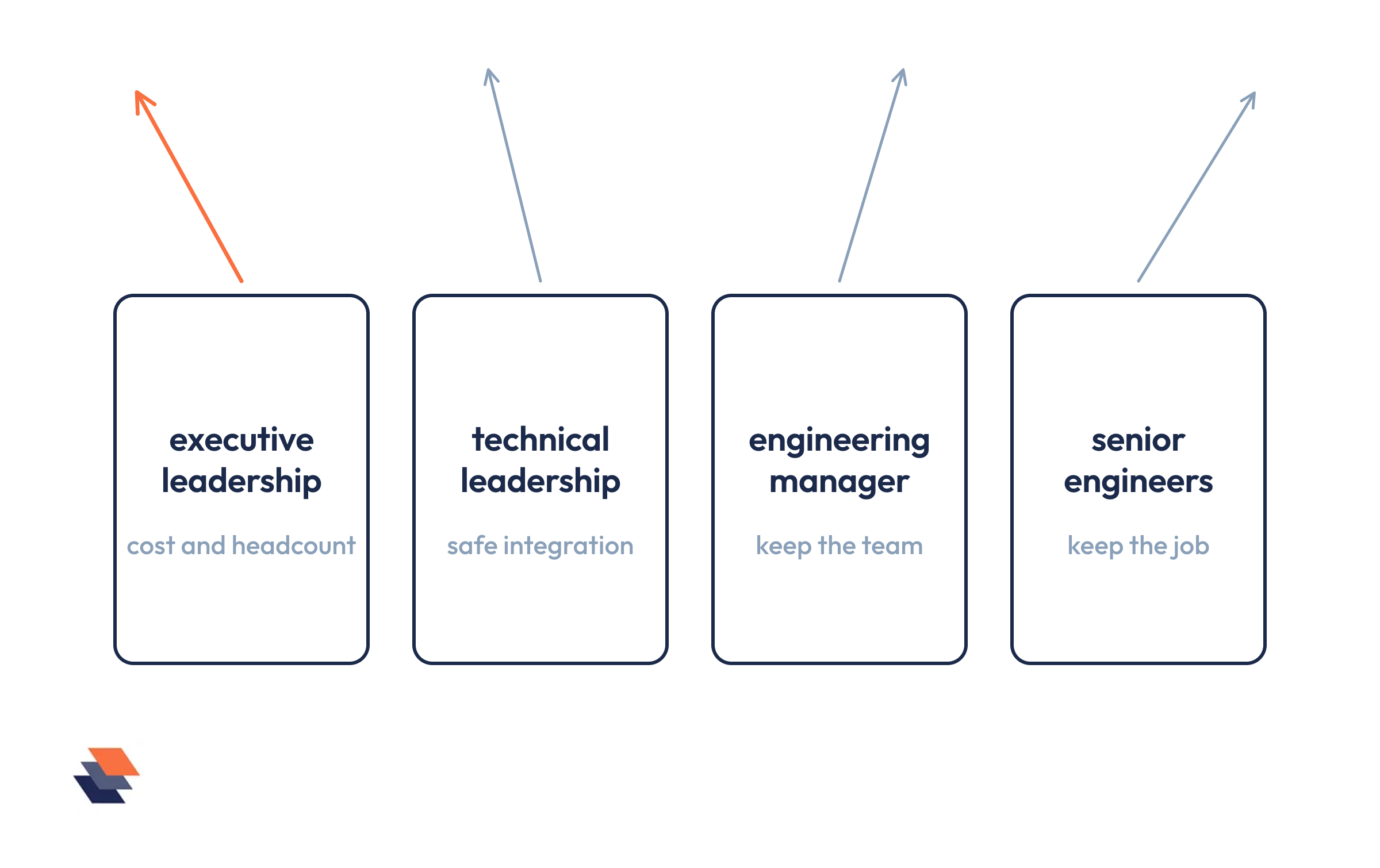
Executive leadership means the nontechnical executives, your CEOs and CFOs, and their voices are the loudest in the room. The leaders of the AI labs talk about curing disease and building superintelligence, and you can’t fault them for that, because putting out moonshots is their job. Outside tech, the message is different. Walmart’s then CEO Doug McMillon and Ford’s Jim Farley both told audiences that AI would change or replace enormous numbers of jobs, and they’re both really big fans of “literally.” Accenture’s Julie Sweet described exiting people on a compressed timeline, and Standard Chartered’s Bill Winters talked about replacing what he called lower-value human capital. The focus is almost universally labor reduction, specifically replacing the back office with AI. Their AI goal is to reduce cost and headcount.
None of those quotes talk about return on investment or profit. For everyone at a for-profit company, the North Star is profit, and profit comes from increasing revenue as much as from cutting cost. That’s the first friction point.
Technical leadership, meaning the CTOs and CIOs, gets told to implement AI as fast as possible so the company is more efficient and can then do layoffs. But technical leaders know AI isn’t magic, no matter how cool the demos look. Complex components used by many departments are hard to modify, and what AI is doing exactly is hard to track. Somebody has to own the outcome when an AI does something wrong. In an atmosphere of fear, people skip the critical steps, like acceptable use policies, human-in-the-loop checks, audit trails, and data and security controls. That’s why my goal around safety is really about risk management.
The versatility of AI makes it useful in almost every business workflow, and that’s exactly what makes it harder to use, because people don’t know what to do with it. It isn’t an upgrade to a tool they already know. They’re not one hour-long workshop away from proficiency, and they need time to practice and integrate what they’ve learned. So technical leaders want AI safely integrated into business workflows.
Accountants already went through this
Technology changes, but how people react to it follows patterns. In 1979, an accountant at a Fortune 500 company copied every transaction by hand into journals and then into large general ledgers. Catching mistakes was the hard part, and a single change could take all day. Then in 1983 Lotus 1-2-3 shipped on the IBM PC, which finance departments already owned, and that’s what drove adoption. Change one number and everything updated, so the job shifted from computing numbers to building and interrogating models.
Data entry and checking stayed part of the job, though. Today AI drafts the reconciliation, categorizes transactions and flags anomalies, while the accountant validates the work and uses the time saved to advise clients. First the math was automated, then data entry, then error checking. None of it eliminated the accountant. The day just shifted from producing to reviewing and supervising.
As an engineer, the slowness of that surprises me, because I would rather take three hours automating something than fifteen minutes doing it. But as an engineer who has tried to drive adoption of tools, it doesn’t surprise me at all. Change is slow. Change is uneven. Change is not automatic. People have to get in there and force every single workflow change.
Managers and engineers feel the cuts
The engineering manager’s AI goal is to hit leadership’s goals while upleveling their engineers. Learning new technology has always been part of the job, and engineers like to learn, so this is an extension of that. When a manager has a solid team of high performers, they want to keep them, and they do it by pointing engineers in the right direction.
The pressure on them is real. According to Challenger, Gray & Christmas, technology companies announced 139,156 job cuts in the first half of 2026, up 83% on the same period last year and nearly a third of all US cuts. AI was the most cited reason for cutting jobs, named in about 23% of all cuts through June. Those cuts are affecting real people in our community, and some of them could be reading this. The long-term view looks like spreadsheets, with more productive workers rather than fewer. What we don’t know yet is how long that takes and what the new jobs will look like. In the meantime, leaders have to work out how to shift the conversation toward productivity, and with the right direction and strategy, our engineers can produce the gains that make that case.
Editor’s note: Michelle’s slides cite 22%, from Challenger’s May report. We’ve used 23% from the June report, the latest available when she gave this talk in July.
Senior engineers are the final persona. I’m currently writing The Software Engineer’s Library, a career guide for senior software engineers coming later this year from Packt, which also publishes Deep Engineering, and I’ve interviewed a diverse set of engineers all over the world for it. AI was obviously top of mind. Engineers want to ship good work while keeping their jobs and learning the new technology, and what they’re doing instead is the next friction point. Every engineer is running their own R&D to figure out the best way to use AI, which is inefficient and creates bottlenecks. Many now pass their days pressing yes every time the coding assistant asks them something. They’re still very task focused, so they get a ticket, have the AI do the work and deploy it.
More code means more reviews
In the talk I played the I Love Lucy scene where Lucy and Ethel wrap chocolates on a conveyor belt that keeps speeding up, and the more they try to keep up, the worse it gets. The development pipeline is doing the same thing. More code means more reviews. You can automate the reviews, but then engineers stop keeping up with changes, and support requests take longer because nobody knows what’s going on.
Adding chat support helps with the simple stuff, but that leaves only the hard problems. I’ve used AI to help diagnose issues, and it can’t figure out what it doesn’t know. Most of us work on big legacy systems with many touch points, so it’s never as easy as reading one repo and explaining it. In the 1960s, people said COBOL was so easy that companies could fire their programmers and let the bankers do the work. Today the few people who can still maintain it are paid a lot of money because of it. If humans will always be in the loop, let’s make the most of them, solving big technical problems and pointing AI in the right direction instead of burning out on support.
Only 6% redesigned the work
Put the four goals side by side and each persona is optimizing for something different. Executives want lower cost and headcount, technical leaders want safe workflow integration, managers want to keep their team delivering on product goals, and engineers want to keep their jobs while learning new tech. With work, they can all be aligned around what’s best for the organization.
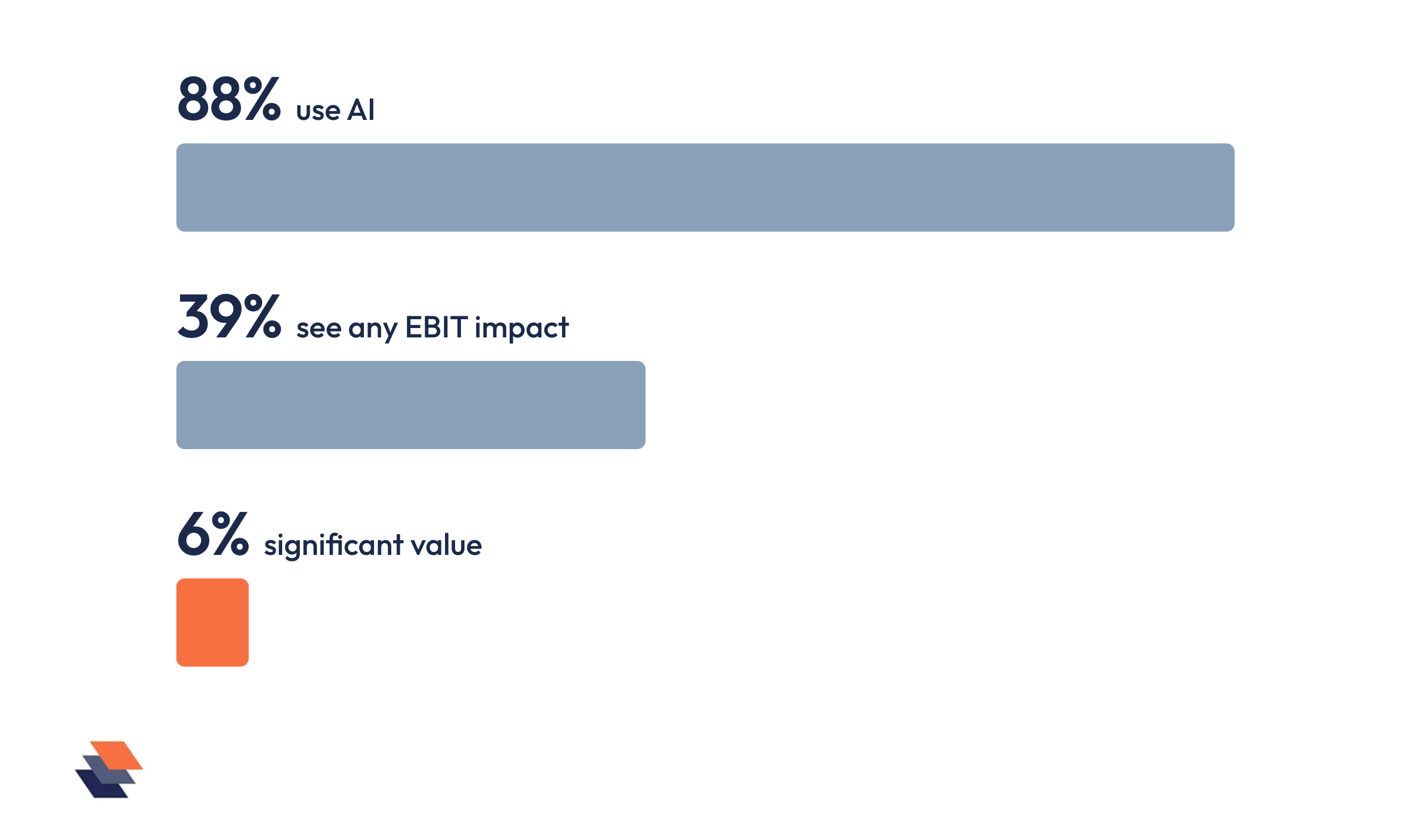
McKinsey’s State of AI survey, published in November 2025, covered about 2,000 organizations in 105 countries. AI use rose from 78% in 2024 to 88% in 2025. But only 39% could attribute any EBIT impact to it, and most of those put the figure below 5%. Just 6% reported significant value. Those companies didn’t add AI to one component, like writing code, and create their own I Love Lucy situation. They went back to basics and redesigned entire workflows. Of all the factors McKinsey tested, fundamental workflow redesign was the one most strongly linked to profit.
Editor’s note: McKinsey’s 2026 survey, published in August, found the same pattern, with nearly three-quarters of high performers fundamentally redesigning workflows against a quarter of other respondents.
Workflow redesign gives all four personas what they want. Executives get reduced costs, technical leaders get a full picture of how AI is used, managers get productivity gains, and engineers get to focus on the work they’re best suited for. That’s the alignment I promised at the start.
Map the workflow before you fix it
For the how, I’m borrowing from the nineties. Consultants have used Six Sigma and Lean for decades, and the approach has a bad reputation because it often comes with layoffs, but its basis is actually the scientific method. The process is DMAIC, which stands for define, measure, analyze, improve and control, and it’s designed to find bottlenecks and smooth them out. It was traditionally aimed at slow bureaucracy. We’re going to aim it at tedious tasks and let AI absorb them.
Continue reading → In the rest of the deep dive, Michelle turns DMAIC on her own workday and comes back with a single digest for five inboxes and checklists that enforce themselves.

🎙️ New Podcasts on Deep Engineering
Two new episodes of the Deep Engineering Podcast, both from leaders already reworking how engineering gets done around agents.
Sibasis Padhi, Staff Software Engineer at Walmart Global Tech, on why AI agents should earn their autonomy step by step, with audit trails and rollback in place before they act.
Vijoy Pandey, SVP and GM of Outshift by Cisco, on organizing engineering around tiny AI teams and TOME, the memory engine his team built.
🛠️ Tool of the Week
pre-commit - framework for managing Git hooks, so teams can run the same checks automatically before commits.
One YAML file declares every hook a repository uses.
Can install hook tooling in isolated environments.
Supports hooks in Python, Node, Go, Rust, Docker and more.
MIT licensed, with v4.7.0 released on 12 October.
📎 Tech Briefs
Microsoft proposes patch risk cohorts - Provisional vulnerability groups help teams prioritize patches by exposure.
Mozilla launches Firefox Enterprise - A self-hosted console manages browser policies and AI use.
DNS root switches signing keys - DNSSEC resolvers need the KSK-2024 trust anchor to avoid resolution failures.
Python 3.15 - The release adds explicit lazy imports and makes UTF-8 the default encoding.
Ruff 0.17.0 - Default Python targets and lint rules change, so review configurations before upgrading.
That’s all for this week. If you take one thing from Michelle, map one workflow end to end before you add another AI tool to it.
Keep building,
Saqib Jan, Editor-in-Chief, Deep Engineering
Partner with Deep Engineering
If your company wants to reach senior developers, software engineers, and technical decision-makers, speak to us about partnering with Deep Engineering