



Join Nacho Martínez Rincón, AI Engineer and Developer Advocate at Oracle, on November 21 for a four-hour, hands-on workshop. You’ll learn to build agents that remember across sessions and retrieve relevant context and tools using the Oracle Agent Memory Package.
🗓️ Sat 21 Nov, 11 AM ET · Book early and save 40%
✍️ From the editor’s desk
Welcome to the 64th issue of Deep Engineering!
On September 10, OpenAI opened its Agents API, offering developers in public beta the same harness behind Codex, together with automatic context compaction for long sessions, parallel tool calling, and coordination between a primary agent and its subagents. What OpenAI learned from scaling Codex is that an agent doing real work needs more than a good model behind it, because the difficulty lies in managing context and keeping the thing running reliably for days at a stretch. So more of the infrastructure for productivity and session context just became something a developer can rent, paying for the tokens and tools they use.
But that leaves the organizational problem exposed. Buying a harness does not establish which sources a business trusts or who decides when two teams want incompatible things at the same time. A managed harness does not, by itself, settle those priorities or assign accountability for an outcome. As delivery units shrink toward one to five engineers, the boundaries between them multiply faster than the teams themselves shrink, and every one of those boundaries needs somebody who owns it.
Vijoy Pandey, SVP and GM of Outshift by Cisco, has been working on that problem inside his own division for a few quarters, moving the division onto small agent-augmented teams and discovering what the move actually cost as the rollout expanded. In our Deep Engineering podcast, he walks through what his group built in response, and his account carries weight because he did not theorize a coordination layer, he built one, found where it failed, and can tell you the team count at which it happened.
Let’s get started.
⚡ Ship Modern Web Apps Faster With AI
AI is changing how web apps get built, and the best developers are already shipping with it. See it live at Prepathon’26, Sep 22-23, two days of free, hands-on sessions on frameworks, workflows, and tools actually making it to production. Seats are limited.
🧠 Expert Insights
AI Is Rewriting Team Topologies and Nobody Owns the Interfaces
by Saqib Jan with Vijoy Pandey
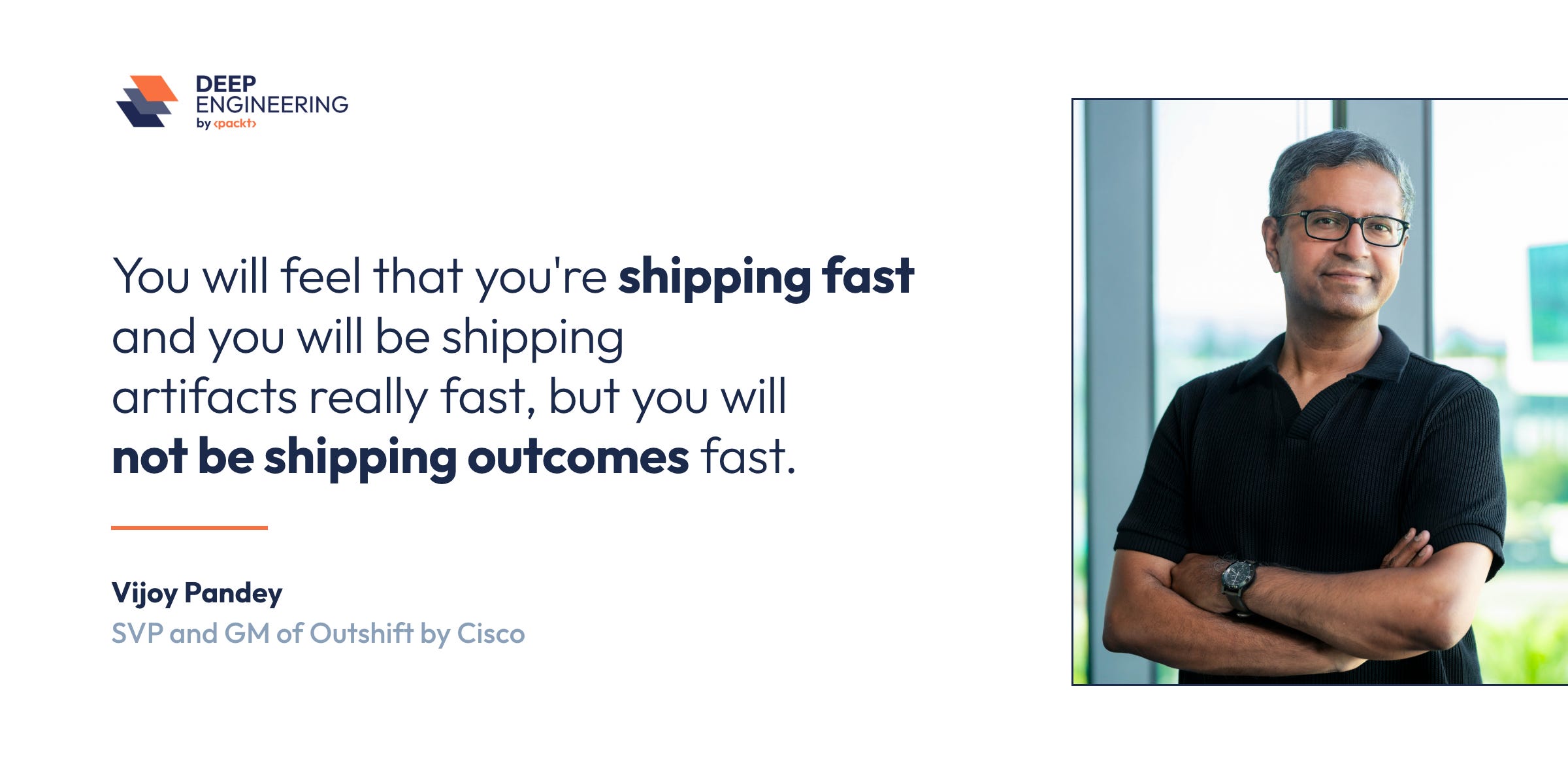
Vijoy Pandey, SVP and GM of Outshift by Cisco, has been rolling out teams of one to five engineers across his division for eight months, and in our latest podcast interview he shares that while choosing the team size was the simplest part of that change, the harder problem appeared on every side of those teams at once, at the boundaries between them, and far sooner than his group anticipated.
Outshift is Cisco’s incubation engine, the group that takes emerging technology areas such as agentic computing and quantum computing, builds products in them, and reduces the risk Cisco carries when it enters a new market. Pandey calls his team model T3, short for Tiny Teams with Tokens, meaning a small group of engineers whose capacity comes from inference spend rather than additional headcount.
There is an industry context for that experiment. On May 5, Brian Armstrong announced a reduction of roughly 14 percent at Coinbase and described a flatter organization built around small, high context teams, including an experiment with one person teams that fold engineering, design and product into a single role. Armstrong cites coordination tax directly as his reason for flattening, and his answer to it is fewer management layers and wider spans of control.
Pandey accepts that reading of the problem while disagreeing about where the solution belongs. “I would actually take that as directionally correct, but not absolutely correct,” he affirms. “Brian and others are right in saying that the teams are shrinking. But then again, the real test is whether hundreds of these can operate as one single company.” What he questions is not whether teams should get smaller, but whether a hundred of them still behave like one company once they do.
AI moved the cost to the seams between teams
Pandey begins from a claim he considers independent of AI entirely. “A business actually needs three systems to function to drive business outcome,” he says. “It needs a productivity unit, it needs a context substrate, and it needs a coordination mechanism.” The productivity unit is the team that makes things. The context substrate is the shared memory telling everyone what is true right now. The coordination mechanism is whatever decides between two teams that want incompatible outcomes.
Agentic development has collapsed the first of those three. A substantial market has grown up around the second, with context and memory platforms arriving from every direction. In Pandey’s view, the third is getting too little attention. “Context is not coordination,” he explains, and that distinction becomes measurable the moment somebody instruments it properly.
Giuseppe Destefanis and Tomaso Aste described an instrument for measuring agent coordination in an August preprint. They represent each execution of a multi-agent coding team as a temporal network in which both the agents and the files they touch become nodes, and each logged message, file write and file read becomes an edge carrying a timestamp and a token cost. Across 1,902 graded executions they find that the finished output alone does not reveal the cost of coordination. A team passes every test without recording what reaching that point cost, and two teams passing identical tests differ severalfold in messages, file activity and tokens consumed. The study used two synthetic Python tasks and one model, so its findings offer a comparison with organizational coordination rather than a direct test of it.
Pandey observes the same blind spot at organizational scale. Artifact generation can keep performing after coordination between teams has degraded, which is why an artifact-velocity dashboard can miss the failure. For an engineering leader auditing this now, the useful measure is the gap between artifacts produced and outcomes actually closed, rather than either number by itself. That gap is worth tracking before it becomes a visible delivery failure.
APIs solved this once and cannot solve it at this size
Pandey’s explanation for why the problem is recurring begins with the previous occasion it appeared. Hard engineering, meaning the work of building cars, rockets and network switches, requires large specialist teams because each person contributes something nobody else on the team can. Cloud computing moved software delivery to what Amazon popularized as two pizza teams, groups of eight to twelve people small enough to feed with two pizzas. And that shift, Pandey points out, made coordination harder rather than easier.
“Coordination is actually moving from intra-coordination in hard engineering teams, which are large, to inter-team coordination in these two pizza teams,” he reasons. “A hundred people, one team, intra-coordination. A hundred people, ten people each, ten teams, inter-team coordination.”
Amazon’s answer became the API manifesto, the internal mandate requiring every team to expose its work through a service interface. As Pandey highlights it with much clarity, “every team would coordinate with the other team that is building a service through APIs, not through design talks, not through meetings.” That mandate turned coordination into something machine readable, and it helped shape how large engineering organizations structured themselves.
Pandey does not believe the same answer carries over to a delivery unit of five. “APIs are not going to be sufficient to solve it,” he says. What changes the equation is not the headcount. “It’s not the size of the team, it’s the fact that the teams are shrinking,” he highlights. “Teams are actually expanding in scope but shrinking in size.” An engineer who wrote code last year now reaches into market requirements, design and customer needs, and that widening scope per person is what multiplies the boundaries, rather than the smaller headcount doing it alone.
The study data gives that intuition a shape, though not the shape the arithmetic predicts. Messaging between agents does grow near-quadratically with team size, at a measured exponent of 1.92 on the researchers’ chained task. Most of that growth comes from first contacts between agent pairs, after which communication per pair falls. Messaging plateaus between eight and sixteen agents as teams increasingly use broadcasts. So the measured quadratic growth is concentrated in initial contacts rather than sustained communication. For anyone budgeting, the implication is to measure actual communication patterns before assuming sustained all-to-all traffic.
Outshift built TOME rather than buying a memory layer
Having identified context as the second system, Pandey’s group built one rather than buying one. They call it TOME, an acronym for the organizational memory engine, and every team writes to it and reads from it. What goes in covers design, decisions, outcomes and the measures attached to those outcomes, together with conflicts and escalations. Pandey flags that last category himself, and it matters more than it appears, because a record of escalations is what makes the coordination layer observable at all.
The first version accepted everything, and the first lesson came back quickly. “Not all sources that feed into TOME are equal,” he says. Every organization, he points out, carries an enormous collaboration surface. Git and GitHub for code, the Atlassian suite of Jira and Confluence for tickets and documentation, Office 365 for presentations and shared Word documents, plus meeting transcripts, Slack messages and email.
“Such a collaboration surface is primed for authoritative source failures,” he underscores, before putting the problem as a set of questions no engineering team answers cleanly. “Who do you trust? Which source do you trust? And now you run into a data architecture problem. And that is unmaintainable at scale.”
That matters because a memory layer with no ranking among its inputs will still answer, and answer confidently. That first version hallucinated, and Pandey’s account of why explains the whole redesign. “You don’t want its best answer. You want the right answer,” he says. The fix inverts an assumption most engineering teams carry without examining it. TOME weights chats and meetings above formal documents, on the reasoning that “that’s the equivalent of a hallway conversation,” because those carry the most recent and most relevant state of a decision. Recency bias, normally something to design against, becomes the design.
For a team preparing to build something similar, that inversion is the transferable part. Rank the collaboration surfaces before ingesting any of them, and rank each one by how close it stands to a live decision rather than by how formal it looks. A wiki page approved six months ago may carry less current information than a Slack thread from Tuesday, but recency does not replace source authority.
The research reaches a similar place on the question of channels, approaching from a different direction. Files, normally treated as passive outputs, function as the one-to-many channel inside an agent team, because one write serves many readers where a direct message reaches only one recipient. Requiring teams to coordinate through shared files rather than direct messages cut output tokens by roughly 42 percent at eight agents on message-heavy work. On chain-shaped work where files already carried the coordination, the same rule only added overhead. So the channel that helps depends on the shape of the work, which is worth measuring in your own environment before copying anyone’s architecture wholesale.
Agent written documents stay secondary sources
Deciding what enters the memory layer turns out to matter more than deciding where to store it, and the rule making TOME governable is one Pandey states plainly. “In the primary sources, humans are the authority,” he says. “In the secondary sources, humans and agents are the authority.”
Anything an agent produces falls on the second side of that line under the current policy, regardless of how polished the output looks. “They are always, always secondary sources,” he says. Because generating a document now costs almost nothing, a store admitting agent output as fact fills with plausible material nobody verified, and retrieval quality degrades until people stop querying it altogether.
The primary sources stay human maintained by the context leads posted between objectives and teams, which is why Pandey treats the coordination pillar as structural rather than administrative. Remove those people and nobody owns the sources of truth, at which point the memory layer degrades into the same collaboration surface it replaced.
Two practical steps follow for a team implementing this. Record provenance at the moment something gets written rather than attempting to reconstruct it later, because an entry that never captured who or what produced it cannot be reliably traced back to its source. And give a named person ownership of each primary source, since the demotion rule only functions when somebody remains accountable for what stands on the other side of it.
Pandey expects the split to change eventually and says that change will take more time. He also keeps a target most organizations would find uncomfortable. “At some point, I want to get rid of all of these collaboration surfaces,” he says, describing an arrangement where people write to TOME first and open a collaboration tool only for artifacts being shared with others.
Context leads earn authority by doing the work
If named people carry that much weight in the model, the obvious question becomes whether naming them changes anything, and here the research complicates the picture usefully. Destefanis and Aste tested nominal coordination by telling one agent in its prompt that it was the coordinator. No communication hub formed around that agent, and no reliable improvement in success followed. A sealed replication at eight agents found no reliable success advantage for coordinator teams under any file policy tested. Their finding is that a team organizes around the structure emerging through its interactions, and a label in a prompt creates none of that structure.
Read against Pandey’s model, the result offers a useful parallel rather than direct validation. His context leads carry work rather than titles. Their responsibilities cover keeping context coherent, deciding at the lowest layer capable of deciding, and moving escalations quickly, and each of those is an activity somebody can be measured against.
The failure case in the study data demonstrates the cost of getting this wrong. An eight-step calculation split one step per agent failed every single execution on a single question, whether to round the figures at each step or once at the end. The rounding convention fell on the boundary between two agents and belonged to neither of them. The teams discussed it in all ten attempts and never settled it, and the finished code executed without error. Decomposition creates interfaces, every interface needs an owner, and the interfaces without one are where the work breaks.
The audit to run this week follows from that directly. Build a boundary inventory listing every seam where one team’s output becomes another team’s input, and put a name against each seam. Any seam without a name is your rounding convention, and it may not announce itself, because the components on either side can appear individually correct while the combined code still executes.
Weigh decisions by blast radius before routing them
Outshift’s structure carries three levels. Objectives at the top, of which a team or a division owns three to five. T3s at the bottom, the delivery unit. Areas in between, because objectives do not map onto teams of five without an intermediate layer, and an area can be functional, architectural or mapped to key results depending on what suits the organization.
Decisions get weighted before anyone routes them. Pandey applies the distinction Jeff Bezos popularized between one way doors, meaning decisions that cost a great deal to reverse, and reversible calls where changing course later costs little. To that he adds two further tests. Whether other teams depend on the outcome, and how much damage a failure causes. “If an outcome from a T3 goes haywire, how bad is it to the team, to the product, to the company?” he says. “Based on the blast radius of that outcome from the T3, that decision holds weight or doesn’t hold weight.”
Reversible, independent, low radius outcomes ship without ceremony, and everything else earns scrutiny proportional to its weight. A team can adopt that scoring on its existing structure tomorrow, starting by agreeing the three tests and applying them when a decision gets recorded.
Pandey’s test for whether the whole apparatus functions is deliberately demanding, and he calls it the 12 a.m. test. “Can I get the what, the why, and the how of the decision that was made for that business outcome at 12 a.m. on a Sunday morning without bothering anybody else?” he says. “If I can do that, TOME is successful.” Pandey says Outshift reached that point, and the test works equally well as an acceptance criterion any team can apply to its own memory layer long before that layer is finished.
Escalations the area leads and objective leads cannot settle reach Pandey’s standup, where they get decided one at a time, and those standups happen at the objective layer deliberately. “You should not be measuring the number of lines of code you wrote,” he says. “Did it solve a customer problem? Are practitioners using what we’ve built? And how quickly is that outcome happening?”
Underneath the whole model is a sentence worth pinning above a whiteboard. “Organizational design is actually a decision-making design,” Pandey says.
Appoint the leads before you build the system
Two things follow for anyone reading this with a shrinking engineering organization.
The first is a threshold below which none of this earns its cost. Under roughly thirty people, Pandey argues, a founder or a small group can serve as the context and coordination layer personally across five to ten teams, and he does not recommend a more formal structure at that size. Outshift encountered the limit of informal coordination during its rollout. The model went to one team first, and in a piece of recursion Pandey clearly enjoys, “the T3 team that was building TOME was actually leveraging TOME to then deliver on TOME.” Three teams followed, then five, then the whole division. “We saw the model start breaking roughly around the five T3 number,” he says. Count delivery units rather than headcount, because forty people across four teams face nothing like the coordination load of forty people across twelve. The figures are rough guideposts from his experience, not universal cutoffs.
The second is a practical recommendation. Naming the people who own the interfaces between teams can begin without building new software, though the study result is a reminder that a title alone does not create effective coordination. Building the memory engine behind those people is a project, and it becomes easier to justify as coordination demands increase. Building it without named owners risks a system nobody maintains, feeding an organization that ships quickly and finishes slowly, which is the failure Pandey identifies at the close of our conversation and one that better instrumentation can help make visible.
Follow Vijoy’s work at Coherent Cognition.
In case you missed
Join Dr. Bruce Powel Douglass on October 31 to explore migration from SysML v1, requirements modeling, and analysis cases through live demonstrations. Registration includes the recording.
🛠️ Tool of the Week
Graphiti — an open source engine for temporal context graphs, built for agents working on data that keeps changing
Tracks when facts become valid and when they are superseded, preserving their history
Links derived facts to source episodes so teams can inspect the underlying evidence
Integrates new data incrementally, without recomputing the graph in a batch job
Combines semantic search, BM25 and graph traversal, so retrieval does not depend on an LLM summarizing first
📎 Tech Briefs
Node.js 26.9.0 - adds built-in benchmarking, enables node:ffi by default, and introduces a generic MAC API.
Microsoft Agent Framework Python 1.18.0- adds shared vector stores and tool-loop duration limits.
Hermes Agent 0.21.3 - fixes refresh-related sign-outs and duplicate session-database writer handles.
AgentCore Evaluations - adds TypeScript support for Strands, LangGraph, OpenAI Agents, and the Vercel AI SDK.
Python 3.15.0rc2 - is available for compatibility testing, with its ABI frozen ahead of the final release.
That’s all for today.
That’s all for this week. If something here changed how you are thinking about your own team boundaries, comment below. I read everything.
Keep building,
Saqib Jan, Editor-in-Chief, Deep Engineering
Partner with Deep Engineering
If your company wants to reach senior developers, software engineers, and technical decision-makers, speak to us about partnering with Deep Engineering.