


As companies integrate advanced AI systems into core workflows, they need engineers who can turn persuasive pilots into reliable production systems. And so, a disciplined hiring approach should define the job, evaluate candidates, structure the team, and keep field learning connected to the product.
Forward deployed engineer postings were roughly 729 percent higher in April 2026 than a year earlier, according to an Indeed index reported by Business Insider. While the figure covers one job board rather than the whole market, the direction is hard to ignore.
Anthropic, OpenAI, Palantir, Stripe, and Google Cloud have all recruited for this role as AI vendors push beyond model access and into enterprise deployment. OpenAI’s current San Francisco role covers discovery through production rollout and measures success through adoption, workflow impact, and feedback that reaches product and model roadmaps.
That broad scope explains the demand, while it also exposes the risk created by weak job descriptions and vague accountability. Hiring teams often select polished customer engineers, strong coders who avoid ambiguity, or heroic generalists who burn out under responsibilities that should belong to a team.
But the strongest operating models define a production outcome, test candidates inside realistic uncertainty, and protect a formal path from customer exceptions back into the product. And they treat forward deployment as a repeatable engineering system rather than a collection of individual rescues performed by unusually resilient employees.
Deep Engineering spoke with three women leading AI delivery, data science, and forward deployed engineering to understand what the role owns and where its operating model fails. Their responses point toward a practical hiring model that values production adoption, technical judgment, customer context, and reusable product learning in equal measure.
Production adoption is what the role actually owns
Useful FDE definitions converge on the same outcome because the engineer remains accountable until a system works inside the customer’s environment and changes a measurable workflow. Discovery meetings, architecture reviews, implementation support, and custom code all matter, but they describe activities rather than the business result that justifies the role.
Ritika Singh, COO at DataGOL, focuses that accountability on the difficult distance between an impressive demonstration and an operating system that survives real data, permissions, compliance gates, undocumented processes, and stakeholders with conflicting incentives. “An FDE is not about a demo, not a signed pilot, not an architecture diagram everyone nods at in a conference room,” she says. Her framing gives hiring leaders a better first line for the job description than the familiar list of customer-facing responsibilities.

Ritika Singh
COO at DataGOL
“The problem with most FDE job descriptions is that they list activities, not accountability.”
“Shipping without extracting the pattern makes you a very expensive contractor. Extracting patterns without shipping makes you an analyst,” Singh explains. Because that balance matters, leaders should translate production adoption into one customer metric and one engineering metric before opening the role for recruitment. The customer metric might track cycle time, exception rate, revenue recovery, or user adoption, while the engineering metric should show whether reliability, evaluation coverage, deployment speed, or reuse improves across engagements.
Write the success line before writing the qualifications, and make it concrete enough that a candidate can explain how they would establish a baseline, Singh recommends. “A strong version says the engineer owns production adoption and measurable workflow impact through rollout, while a weak version merely promises exposure to strategic customers and frontier technology.”
A new title covers an old operating gap
Palantir popularized the forward deployed model by embedding technical teams with customers, but the current AI hiring wave has broadened the title across product companies, frontier laboratories, consultancies, and infrastructure vendors. That matters because many employers now use one label for several jobs with different incentives, customer loads, and definitions of finished work.
In many organizations, solutions engineering helps a buyer understand the product, validates a possible architecture, and reduces technical risk before a purchase. A builder-style FDE stays through production, contributes working code, owns adoption, and converts repeated exceptions into product capabilities that make later deployments faster and safer.
The practical distinction appears in the weekly calendar and the performance scorecard rather than the title printed on an offer. A role built around many accounts, demonstrations, technical qualification, and revenue-linked compensation behaves like pre-sales, while a role built around a few deep deployments, production ownership, and documented reuse behaves like forward deployed engineering.
Companies can operate either model successfully, but candidates and managers need an accurate description of the work before they commit. Renaming a solutions role without changing the customer load, decision rights, engineering expectations, or product feedback loop creates confusion for employees and weak results for customers.
⚡ Forward Deployed Engineering Workshop
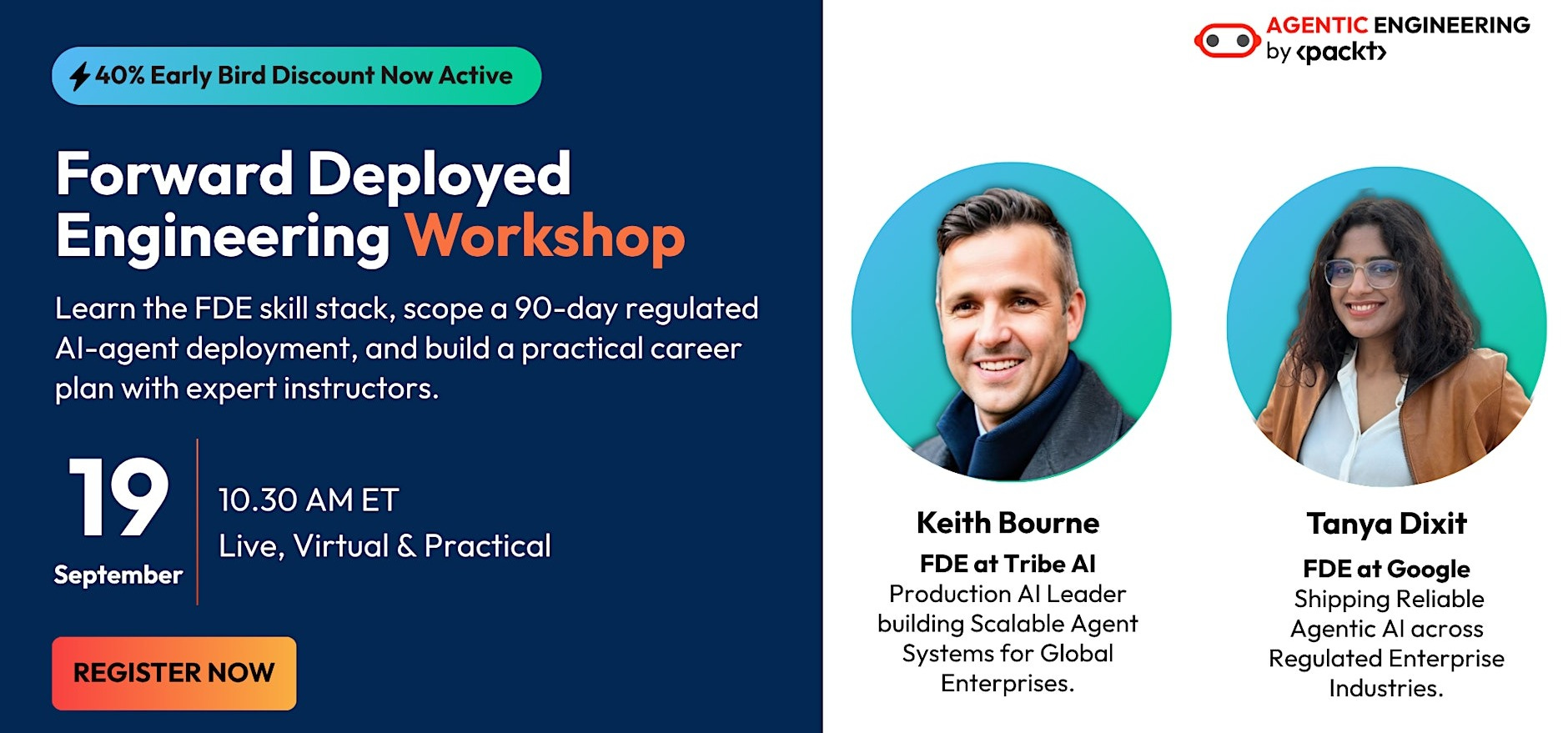
Keith Bourne, Forward Deployed AI Engineer at Tribe AI, and Tanya Dixit, Forward Deployed Engineer at Google, will lead two live sessions. You will map the FDE skill stack, scope a 90-day agent deployment for a regulated customer, and defend it in a CISO hot seat.
September 19 and 20. Reserve your seat
Hire the function only when the economics support it
Dedicated FDE headcount earns its place when strategic customers have genuinely different environments, repeated deployment friction keeps revealing useful product patterns, and the contract economics can support deep engineering attention. Without those conditions, a company usually needs clearer templates, stronger onboarding, better product defaults, or a conventional post-sales motion before it needs a new function.
Singh argues that teams should reserve FDE capacity for complex, high-value accounts instead of spreading expensive engineers across every customer. “Spread across every deal, the role burns out fast,” Singh reasons. “Applied surgically to the deals that actually move the company, it is one of the highest-leverage hires you can make.” Her threshold protects the role from becoming an unlimited customization queue, while preserving enough concentrated field exposure to uncover patterns that the core product team could not see from roadmap discussions alone.
A useful planning test compares the expected customer value with the fully loaded deployment cost, including travel, security reviews, support load, and productization time. The model improves only when later deployments reuse earlier work, so leaders should expect cycle time and custom code to decline as the function matures.
Travel and customer load belong in that economic model because they shape performance, retention, and the number of deployments one engineer can own. OpenAI’s current posting allows travel up to 50 percent, which shows why leaders must disclose the real operating rhythm instead of treating travel as a minor line near the end.
Write the job around decisions and boundaries
A strong job description opens with the production outcome and then states the ownership arc from discovery through stable rollout. It explains whether the engineer writes customer-specific code, changes the core product, carries an on-call obligation, manages the deployment plan, or relies on separate delivery and program leadership.
Next, define decision rights across scope, architecture, security, and customer commitments, because ambiguity becomes expensive when a deployment is already under pressure. Candidates should know which tradeoffs they can make independently, which decisions need customer approval, and who resolves conflict between a near-term delivery request and the long-term product direction.
Then expose the workload through expected travel, number of concurrent customers, engagement length, escalation coverage, and protected productization time. These details help serious candidates assess the job, while discouraging applicants who want customer visibility without the sustained engineering and operational responsibility that follows the sale.
State the non-goals with equal clarity, because FDEs should not become permanent support engineers, unbounded professional services, or convenient owners for every cross-functional gap. The job should end a one-off dependency by creating a reusable component, a tested integration pattern, a documented limitation, or a clear product decision.
Interview for how agentic systems fail
Once the role is clear on paper, the hiring loop must test whether candidates can diagnose the failures they will encounter inside a customer environment. Agentic AI makes that evaluation harder because a system can complete a task while taking the wrong path, using weak context, calling unnecessary tools, violating an approval boundary, or consuming more budget than the business value it creates. Traditional pass or fail testing cannot reveal enough about that behavior when permissions, exceptions, costs, and customer conditions keep changing.
Swati Tyagi, Senior Manager in Data Science and AI/ML at Tredence, argues that trace-level behavior now matters alongside final output quality. Her view expands the technical bar for FDE hiring beyond model familiarity and toward the observability, evaluation, permissions, and business controls required for reliable production operation.

Swati Tyagi
Senior Manager in Data Science and AI/ML at Tredence
“With agents, the system may technically be working while still choosing the wrong tool, using incomplete context, taking an inefficient path or consuming far more tokens than expected.”
“An automated refund agent, for example, may execute perfectly but still create financial leakage by approving the wrong refunds,” Tyagi says. She recommends replacing a generic AI coding screen with “a broken agent trace that shows plausible output, inefficient tool selection, a permissions flaw, and a business loss hidden behind acceptable aggregate metrics.” Ask the candidate to isolate the failure, define the missing instrumentation, propose an evaluation set, and describe the rollback or human review boundary. This exercise shows how the candidate investigates ambiguous behavior and whether that person can protect the business while repairing the underlying system.
And the strongest response will connect technical behavior to business consequences without treating either side as somebody else’s responsibility, while distinguishing a fix for this customer from a reusable improvement to the harness, evaluation framework, permission model, or product interface that prevents the same failure elsewhere.
Build a unit instead of hiring a superhero
Tyagi also warns that companies often write one job description for several people, combining customer discovery, domain expertise, AI engineering, data architecture, organizational change, and production ownership into a single heroic profile. “The scalable unit is the team, not the individual,” she cautions. Exceptional generalists exist, but a hiring plan that assumes every seat will hold one creates a fragile operating model and a narrow talent funnel.
Anthropic’s current hiring model offers a useful example as a separate Technical Deployment Lead owns scoping, stakeholder management, value measurement, and delivery complexity while working alongside FDEs who build the technical solution. That separation keeps technical execution close to customer reality without forcing every engineer to carry the entire commercial and organizational burden alone.
A scalable deployment unit pairs the FDE with a product counterpart, a customer domain owner, and shared platform, security, or governance support that can move quickly. The exact composition can change by engagement, but every responsibility needs an explicit owner before the team enters a production environment.
Because the FDE remains the technical integrator closest to the customer, the team should not dilute that person’s ownership through endless handoffs. The surrounding unit exists to remove specialist bottlenecks and clarify decisions, while the FDE keeps the system, workflow, and customer outcome connected from discovery through adoption.
Put the function near engineering and protect the product loop
Reporting lines shape the product loop because incentives decide whether field learning becomes durable software or disappears inside delivery work. A revenue-only system naturally rewards closing the current engagement, while an engineering system can also reward reducing future deployment effort and improving the underlying product.
Singh (of DataGOL) places the function inside engineering or a tight engineering and product hybrid, with constant collaboration across go-to-market teams but technical leadership over goals and development standards. “The mistake is having their goals, comp, and reporting line resolve to revenue rather than to product,” she says. That structure protects customer urgency without turning FDEs into consultants whose success ends when the statement of work closes.
Keep the technical reporting line, then add shared objectives with product and a regular review where field patterns receive an explicit disposition. Every recurring exception should become a reusable component, a roadmap decision, a documented product boundary, or a deliberate services commitment, rather than an unresolved note in a customer channel.
Singh proposes roughly 70 to 80 percent of capacity on customer delivery and about 20 percent on productization. The exact ratio will vary, but a protected allocation matters because the product loop disappears whenever leaders treat reuse as optional work that can wait until customer pressure falls.
Measure that loop through deployment cycle time, reuse rate, recurring defect classes, custom code retired, and field-originated product changes that reach general availability. These metrics show whether forward deployment compounds into a better platform or simply accumulates expensive customer-specific debt behind a fashionable title.
Design the first ninety days around one reusable win
The first ninety days should prove the operating model rather than test how much ambiguity a new hire can absorb without help. Leaders need to provide customer access, technical context, product sponsorship, and a deployment with enough importance to matter but enough support to become a learning environment.
Singh describes strong early performers as people who separate the blocker a customer states from the constraint that actually prevents adoption, then ship one visible improvement before the relationship loses momentum. “Those are rarely the same thing,” she says. Misfires remain in discovery, stay distant from the customer, or produce throwaway work that cannot help the next deployment.
During the first thirty days, the new hire should map the customer workflow, establish baseline measures, document system boundaries, and identify the decisions that could block production. The manager should evaluate the quality of diagnosis and access gained, rather than rewarding a premature volume of code.
Between days thirty-one and sixty, the engineer should deliver one safe, visible win with evaluation, observability, rollback, and adoption responsibilities included. The result should improve a customer metric while producing enough technical evidence to guide the larger deployment plan.
By day ninety, the engineer should convert one lesson into a reusable asset and present the pattern to product and engineering leadership. That artifact might be an integration component, evaluation suite, deployment playbook, permission pattern, or product proposal with evidence from the customer environment.
Make the career path visible before the first offer
Retention depends on whether forward deployment expands an engineer’s authority or traps that person inside a permanent queue of exceptions. Candidates will accept demanding customer work when it builds technical range, domain credibility, product influence, and a visible path toward broader leadership.
Jayeeta Putatunda, Forward Deployed AI Engineering Lead at Turing, sees the role as a durable response to the execution gap between controlled AI capability and enterprise production. At Turing, she also sees the career ceiling arriving when companies consume deployment effort without returning agency or product influence.

Jayeeta Putatunda
Forward Deployed AI Engineering Lead at Turing
“After two years, strong FDEs could move into product, platform engineering, vertical leadership, solution architecture, or larger deployment leadership. The ceiling would appear only when companies treat them as permanent exception handlers, moving from one bespoke proof of concept to another without giving them influence over the product.”
“What will hold good FDEs is agency, deeper domain ownership, a voice in the roadmap, and recognition for turning lessons from one client into capabilities that can benefit many,” Putatunda says. Turn that career map into explicit levels before recruiting the first team, with progression based on deployment complexity, reusable leverage, technical influence, and the ability to develop other engineers. But promotion should not depend on accepting more customers at once, because volume alone rewards the behavior that eventually damages quality and retention.
Compensation should recognize travel, incident responsibility, customer pressure, and the market value of engineers who can operate across technical and organizational boundaries. But autonomy, roadmap influence, recovery time, and movement into product or platform leadership will often determine whether strong people stay after the initial learning curve.
A better hiring model starts with a narrower promise
The FDE title may change as AI roles continue to evolve, but the operating gap will remain wherever a capable model meets a complicated customer environment. Companies still need engineers who can diagnose the real workflow, ship production software, guide adoption, and carry field evidence back into the product.
Engineering leaders should narrow the promise before expanding the headcount, because the role works when its outcome, customer scope, decision rights, technical bar, productization time, and career path are visible. That clarity produces better interviews, more honest offers, stronger deployments, and a healthier relationship between customer urgency and product quality.
And because the market is moving quickly, disciplined role design now creates an advantage that compensation alone cannot sustain. The companies that learn from every deployment will build stronger products, while the companies that celebrate individual heroics will keep paying for the same exception in different customer environments.
📣 Contribute to Deep Engineering
If you lead a team, we would like to interview you and build an engineering leadership feature around your story. If you are a senior engineer with something you have learned in production, pitch a practical deep dive under your byline.